
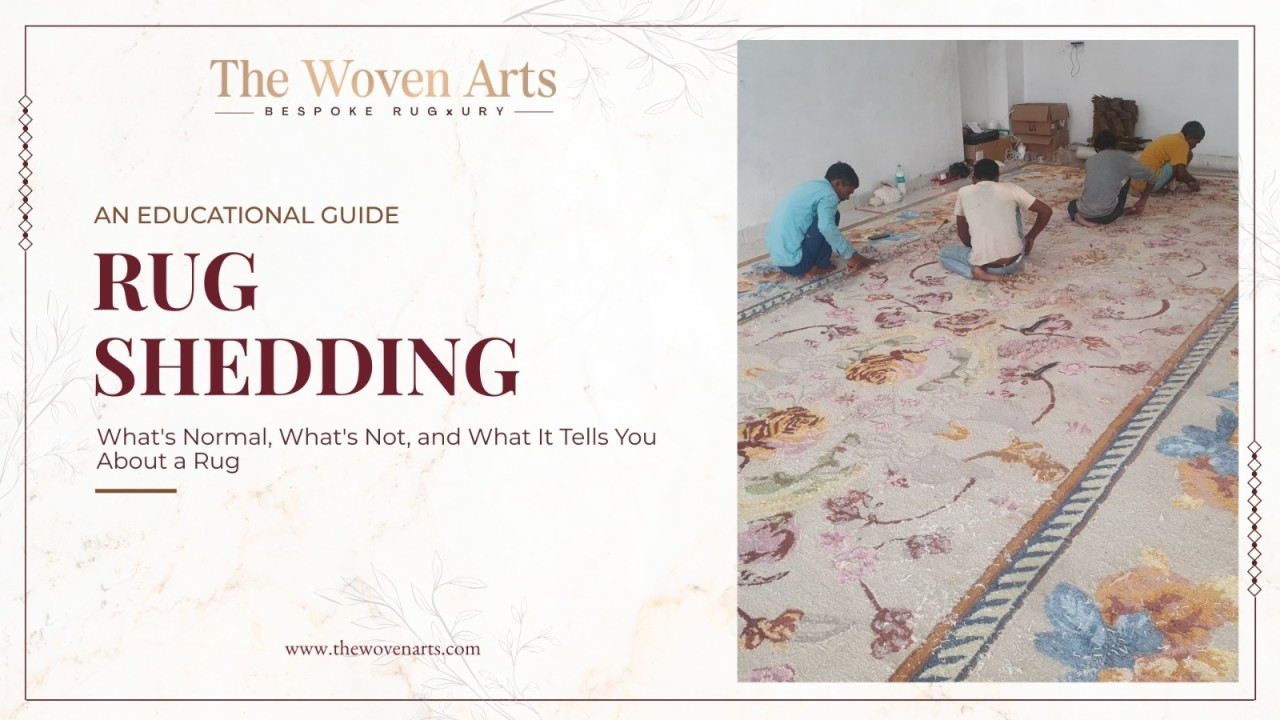
Rug Shedding: What’s Normal, What’s Not, and What It Tells You About a Rug
A new rug can look perfect when it is first installed. Then, after a few days of walking and vacuuming, you may notice a fine layer of fibre appearing on the surface.
The immediate question is usually “Is something wrong with the rug?”
Not necessarily.
Some shedding is a natural part of the life of certain rugs, particularly those made with staple fibres such as wool. But there is an important difference between normal fibre release and excessive or structural fibre loss.
Understanding that difference can tell you a great deal about the quality, construction and expected performance of a rug.
What Exactly Is Rug Shedding?
Shedding occurs when loose or excess fibres work their way out of the rug during the early stages of use. With a well-made rug, this should generally reduce as the rug settles into its environment and receives regular, appropriate maintenance.
The amount of shedding can vary depending on several factors:
- The type and quality of fibre
- Fibre length and strength
- Yarn construction
- Density of the rug
- Manufacturing technique
- Finishing process
- How the rug is vacuumed and maintained
This is why simply seeing some fibre on a new rug does not automatically mean the rug is defective.
When Should You Pay Attention?
The more important question is not “Does the rug shed?”
It is “How is the rug shedding?”
If you notice a small amount of loose fibre during the initial period, particularly with wool, that can be perfectly reasonable. However, excessive fibre loss deserves closer attention.
For example, if the surface continues producing significant amounts of loose material over an extended period, or if individual yarns can easily be removed from the construction, there may be an underlying issue.
Look Beyond the Surface
One of the simplest ways to understand rug quality is to examine how securely the yarn is integrated into the rug.
Gently inspect the surface and observe the behaviour of the fibres.
Does the yarn feel firmly anchored?
Does the pile remain stable when touched?
Or do individual strands seem unusually easy to pull free?
A rug is designed to withstand repeated interaction, footsteps, furniture, cleaning and everyday use. The fibres should therefore work as part of a stable construction rather than behaving like loose material sitting on top of the rug.
The Difference Between Shedding and Pulling
Shedding is primarily about loose fibres gradually leaving the surface. Pulling is different. It occurs when individual yarns or loops become displaced or can be pulled out of the construction.
That can potentially lead to:
- Snagging
- Visible gaps
- Uneven pile
- Fibre loss
- Damage from vacuuming or everyday traffic
A rug can therefore have some initial shedding and still be well constructed, while a rug with little visible shedding may still have weaknesses in its construction.
Construction Matters More Than Appearance
Two rugs can look almost identical when displayed in a showroom and behave very differently after installation. The difference may be hidden beneath the surface.
Density, yarn quality, knotting or tufting technique, backing, finishing and workmanship all contribute to how a rug performs over time.
This is particularly important when selecting rugs for high-traffic residential spaces, hospitality projects, offices or commercial interiors.
A Simple Inspection Before Specifying a Rug
Before selecting a rug for a project, take a few moments to examine it closely.
- Run your hand across the surface.
- Look at the pile from different angles.
- Check the edges and finishing.
- Examine the backing where possible.
- Ask about the fibre, construction and expected maintenance requirements.
The goal isn’t to find a rug that never releases a single fibre. The goal is to understand whether the rug’s behaviour is appropriate for its material and construction.
Quality Reveals Itself Over Time
In the world of rugs, quality is rarely determined by appearance alone. It is revealed through consistency, how the yarn behaves, how the pile responds to use, how the surface ages and how well the construction holds together.
For designers, architects and clients, understanding these details can make the difference between selecting a rug that simply looks beautiful and specifying one that continues to perform beautifully for years.
True rug quality isn’t just about what you see. It’s about what happens after thousands of footsteps.
If you're specifying a rug for an upcoming project and want to talk through construction, fibre, or finishing before you commit, reach us at info@thewovenarts.com.
The Woven Arts – Bespoke Rugxury
Delivered Worldwide.

Rug Scale Matters: The Foundation of Every Great Interior
O ne of the most common mistakes I see in living spaces? An undersized rug that appears to float beneath the furniture.
When a rug is too small for the furniture it's meant to anchor, it disrupts the entire composition of a room. Even the most premium interiors can feel visually compressed, disconnected, and incomplete.
Through our work with designers and architects, we've learned that rug scale is one of the most intricate aspects of interior design. Balancing proportions, layout, and intent requires careful, deliberate thought.
A well-scaled rug anchors the furniture, defines the layout, and creates a sense of cohesion. When done right, it visually expands the room, bringing balance and flow. When done wrong, it fragments the entire space.
At The Woven Arts, we treat every rug as a foundational design element, one that sets the tone for the entire interior.
Get the scale right, and everything else falls into place.
We collaborate closely with designers and architects to create bespoke rugs tailored to your exact space and vision. If you're working on a project and want to explore what's possible, reach out — we'd love to be part of it. Visit us at www.thewovenarts.com
Ready to Create a Bespoke Rug?
Custom sizes. Custom colours. Custom craftsmanship.
LET'S CUSTOMIZE A RUG