
Why Two Hand-Tufted Rugs Can Be Quoted at Very Different Prices
A client sends us two quotations for what looks like the same rug and asks the same question every time:
"Why is one supplier cheaper?"
The answer usually lies in the specification of the rug, not in the supplier's margin.
Hand-tufted describes how a rug is made, not how well it is made.
This is one of the most important distinctions when specifying handmade rugs, and it is the one most often missed at the quotation stage.
What Makes Two Rugs Different?
Two rugs can both be hand-tufted and still differ significantly in:
- Yarn quality and construction
- Fibre: wool, viscose, bamboo silk or blended yarn
- Tuft density
- Tuft gauge
- Pile height
- Pile weight
- Primary backing
- Latex or binder system
- Secondary backing
- Shearing
- Carving
- Finishing
- Quality-control standards
Each of these differences influences the final appearance, feel, durability and performance of the rug. Several of them are invisible once the rug is on the floor, which is why they are the easiest places for cost to be removed.
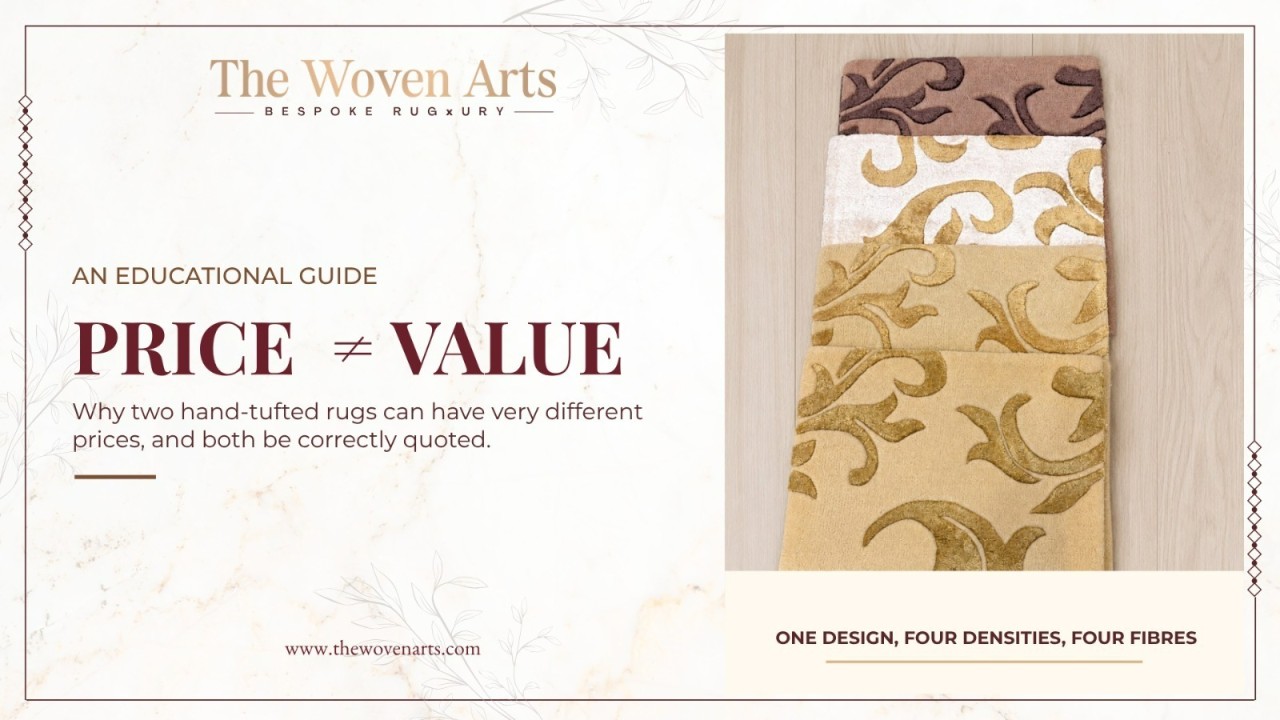
We Made the Difference Physical
Rather than describing this in the abstract, we recently produced one design across four different densities and fibres, so the difference could be seen and felt side by side in the same pattern. The photograph with this edition is that sample.
Why Density Matters
Tuft density describes how closely the yarn sits within the backing.
An appropriate density contributes to a more compact surface, better pattern definition and improved tuft security.
But density should never be read in isolation. A dense rug made with unsuitable yarn or a poor backing system is not automatically a better rug. The construction has to work as a system.
The Backing Matters Just as Much
The primary backing is the foundation the yarn is tufted into. Its stability, strength, weave and compatibility with the yarn all determine how securely the tufts are held.
The latex or binder then locks the construction together. The secondary backing adds protection, stability and a finished underside.
So when you compare two quotations, the face of the rug doesn't tell the whole story, and the parts you cannot see do a lot of the work.
How to Compare Properly
Compare like for like. Ask both suppliers for the same nine specifications:
Yarn → Pile Height → Pile Weight → Tuft Density → Gauge → Primary Backing → Latex or Binder → Secondary Backing → Finishing
If those specifications differ, you are not comparing the same product. You are comparing two different constructions that happen to share a drawing.
The question is not "Who is cheaper?" It is "What exactly am I getting for this price?"
Where We Stand
At The Woven Arts, we quote with the full specification so designers, architects, and clients can make informed decisions.
We do not believe every project needs the most expensive rug. A guest bedroom and a hotel lobby have genuinely different requirements, and specifying for the lobby in both is not craftsmanship. It is waste.
A lower price can be exactly the right choice. It only becomes a problem when nobody has told you what changed to achieve it.
Hand-tufted is the construction method. Quality is in the specification.
A Question for the Specifiers Reading This
When you request rug quotations, do you issue a specification and ask suppliers to price it, or do you ask each supplier to propose one?
I would like to know which way round it usually works on your projects, because the answer changes how we should be writing ours.
Send us a specification you have been quoted, and we will give you a like-for-like comparison against ours.
The Woven Arts. Bespoke rugs, specified with purpose.

Rug Scale Matters: The Foundation of Every Great Interior
O ne of the most common mistakes I see in living spaces? An undersized rug that appears to float beneath the furniture.
When a rug is too small for the furniture it's meant to anchor, it disrupts the entire composition of a room. Even the most premium interiors can feel visually compressed, disconnected, and incomplete.
Through our work with designers and architects, we've learned that rug scale is one of the most intricate aspects of interior design. Balancing proportions, layout, and intent requires careful, deliberate thought.
A well-scaled rug anchors the furniture, defines the layout, and creates a sense of cohesion. When done right, it visually expands the room, bringing balance and flow. When done wrong, it fragments the entire space.
At The Woven Arts, we treat every rug as a foundational design element, one that sets the tone for the entire interior.
Get the scale right, and everything else falls into place.
We collaborate closely with designers and architects to create bespoke rugs tailored to your exact space and vision. If you're working on a project and want to explore what's possible, reach out — we'd love to be part of it. Visit us at www.thewovenarts.com
Ready to Create a Bespoke Rug?
Custom sizes. Custom colours. Custom craftsmanship.
LET'S CUSTOMIZE A RUG